Divine Mercy Sunday
Wounds As Your Super Power
PEACE BE WITH YOU
1.PRAYER
God of locked rooms and scarred hands, we bring our doubts, questions, and unfinished faith. Breathe peace into what feels trapped. Show us that wounds are not failures but openings where mercy enters, and courage is born. Amen.
2. SHARING YOUR STORY
Share a time when a defeat or weakness actually turned into a benefit or strength.
3. STORIES AROUND THE GLOBE
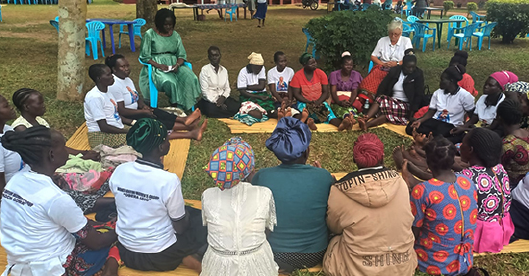
Formerly abducted women gather for a peace-building circle—sharing stories and learning restorative and trauma-healing practices.
Immaculate Adong’s life began in violence and loss. At eight, the Atiak massacre killed her father and left her family destitute in northern Uganda. Hunger and poverty pressed in from every side. Survival demanded courage she did not yet know she had. Guided by her mother’s faith, Immaculate scavenged for recyclables, harvested crops, and knitted goods to sell, working tirelessly so her siblings could eat and return to school. Her hardships became her teachers. At eighteen, she helped rebuild her family’s home with bricks she made from sand and a roof fashioned from scrap. She discovered patience, resilience, resourcefulness, and compassion for others. Each challenge strengthened her leadership and confidence. Maryknoll missioners accompanied her, offering mentorship and encouragement that transformed wounds into wisdom. Today, she manages the Wawoto Kacel Cooperative in Gulu, empowering women, many formerly abducted, to heal, share their stories, and build community. Her past fuels advocacy, her empathy inspires, and her story shows that with courage, accompaniment, and community, suffering can blossom into new life. (Immaculate’s path from survival to leadership by Joanne Blaney, Maryknoll Lay Missioners, Sept. 23, 2025)
4. GOSPEL STORY
On the evening of that first day of the week, when the doors were locked, where the disciples were, for fear of the Jews, Jesus came and stood in their midst and said to them, “Peace be with you.” When he had said this, he showed them his hands and his side. The disciples rejoiced when they saw the Lord. Jesus said to them again, “Peace be with you. As the Father has sent me, so I send you.” And when he had said this, he breathed on them and said to them, “Receive the Holy Spirit. Whose sins you forgive are forgiven them, and whose sins you retain are retained.” Thomas, called Didymus, one of the Twelve, was not with them when Jesus came. So the other disciples said to him, “We have seen the Lord.” But he said to them, “Unless I see the mark of the nails in his hands and put my finger into the nailmarks and put my hand into his side, I will not believe.” Now a week later his disciples were again inside and Thomas was with them. Jesus came, although the doors were locked, and stood in their midst and said, “Peace be with you.” Then he said to Thomas, “Put your finger here and see my hands, and bring your hand and put it into my side, and do not be unbelieving, but believe.” Thomas answered and said to him, “My Lord and my God!” Jesus said to him, “Have you come to believe because you have seen me? Blessed are those who have not seen and have believed.” Now, Jesus did many other signs in the presence of his disciples that are not written in this book. But these are written that you may come to believe that Jesus is the Christ, the Son of God, and that through this belief you may have life in his name. John 20:19-31
5. REFLECTION ON THE READINGS
The disciples are locked in fear. Jesus doesn’t scold them—he breathes peace. He doesn’t hide his wounds; he offers them. Thomas isn’t shamed by Jesus for needing proof; rather, he’s invited closer in an intimate encounter with Jesus’s wounds. This is mercy: not denial, not perfection, but an honest relationship. Resurrection doesn’t erase the cross or the wounds and scars it caused, but rather it transforms the pain and loss into new life. And then comes the sending. Peace is not an endpoint; it’s fuel for mission. We are sent as wounded people to a wounded world, not to fix it, but to stay present, forgiving, and real.
6. FAITH SHARING
What wounds, personal or communal, is the Spirit inviting you to see as new sources of compassion rather than shame, particularly to share with those who have also been wounded or shamed by society?
7. GO FORTH
This week, choose one concrete act of presence with people whose wounds are often ignored or shamed, either locally or globally. Volunteer one hour at a shelter, accompany a migrant or refugee family, write or visit someone who is incarcerated or isolated, or intentionally learn from a community elsewhere in the world facing injustice through the voices of missioners, partners, or grassroots leaders. Don’t rush to fix. Listen. Learn. Let their reality change how you see your own wounds. This is solidarity.
8. PRAYER
God of mercy, we thank you for a peace that does not erase our wounds but breathes gently through them. Empower us through our woundedness and scars to be more empathic. Help us practice forgiveness, to stay present when it would be easier to withdraw, and to make space for healing where pain still speaks. Amen.