Palm Sunday of the Lord’s Passion
Who do you want to Crucify?
TRULY, THIS WAS THE SON OF GOD!
1.PRAYER
Suffering Christ, you carry the weight of our violence and shame. Help us recognize you in the crucified of today—those rejected, abused, or forgotten. Let your mercy tear the veils of indifference and restore hope in our world. Amen.
2. SHARING YOUR STORY
Recall a time when standing with someone suffering cost you something—comfort, reputation, or safety. What did you learn?
3. STORIES AROUND THE GLOBE
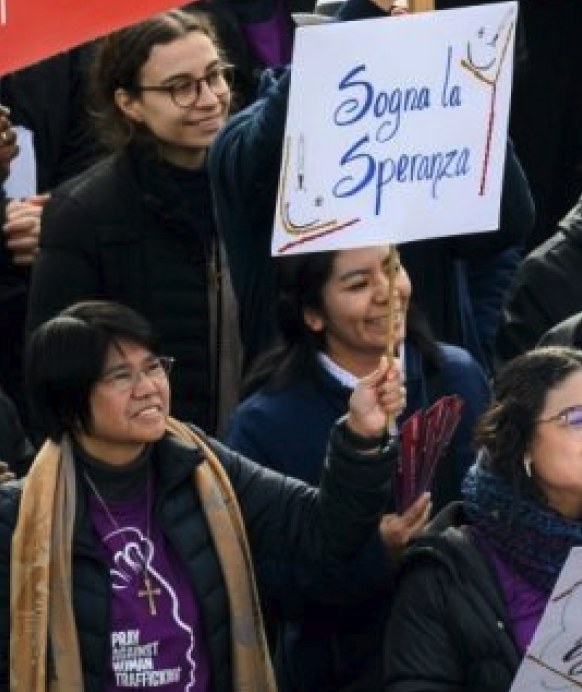
Maryknoll Sister Abby Avelino, international coordinator of Talitha Kum, an international network of religious working against human trafficking, far left, joins young people mobilized against human trafficking in St. Peter’s Square for Pope Francis’ recitation of the Angelus prayer at the Vatican Jan. 19, 2025. (CNS/Vatican Media/Vatican City)
Mariana crossed borders chasing a promise of safety and work, only to find endless labor, threats, and confinement. Fear gripped her, and she worried for her granddaughter’s safety. Finally, she ran.
Enrique left Guatemala seeking work to support his family. Kidnapped and forced into labor, he endured violence and exploitation as part of the hidden machinery of human trafficking.
Maryknoll missioners step into the lives of people like Mariana and Enrique, walking alongside those crucified by today’s injustices. Through Las Americas Immigrant Advocacy Center, they help survivors regain safety and legal protection. In Brazil, the Institute for Land, Work, and Citizenship partners with them to support women deceived into forced labor and coerced criminality. Maryknoll Lay Missioner Heidi Cerneka gives testimony before the Inter-American Commission on Human Rights, amplifying the voices of the silenced.
Standing with the crucified costs comfort, safety, and reputation, but it transforms despair into justice and suffering into solidarity.
4. GOSPEL STORY
Here is a summary of the Gospel (be sure to read the full story in Matthew 27:11-54). In the Passion according to Matthew, Jesus stands before Pontius Pilate, silent before his accusers. Pilate, recognizing his innocence, offers the crowd a choice between freeing Jesus or Barabbas, a notorious prisoner. Persuaded by the chief priests, the crowd demands Barabbas’ release and cries out for Jesus’ crucifixion. Pilate publicly washes his hands, declaring himself innocent of Jesus’ blood, yet hands him over to be scourged and executed.
The soldiers mock Jesus cruelly—dressing him in a scarlet cloak, placing a crown of thorns on his head, and hailing him as “King of the Jews.” On the road to Golgotha, Simon of Cyrene is forced to carry the cross. There, Jesus is crucified between two revolutionaries under the mocking gaze of onlookers who challenge him to save himself. Even as he suffers, they fail to see that his kingship is not about power or escape but about love poured out in surrender.
At noon, darkness covers the land. Near death, Jesus cries out, “My God, my God, why have you forsaken me?”—entering fully into human suffering and abandonment. With a final cry, he gives up his spirit. At that moment, the earth quakes, the temple veil tears in two, and tombs are opened—signs that creation itself responds to the death of the Son of God. The centurion and his men, witnessing these events, proclaim in awe, “Truly, this was the Son of God.”
5. REFLECTION ON THE READINGS
The crowd screams, “Crucify him.” The cross exposes not only the cruelty of violence but also its futility. In the face of hatred, betrayal, and indifference, Jesus does not retaliate—he loves. His silence before Pilate, his forgiveness from the cross, and his final cry of surrender reveal that God’s response to human brutality is mercy, not revenge. Standing at the cross means standing with those the world crucifies today: migrants abandoned at borders, prisoners forgotten in cells, the poor dismissed as expendable, and creation itself, groaning under our neglect. To accompany them is to recognize the sacred ground of restoration—where suffering love still redeems the world. The torn veil in the temple signals that no barrier can separate us from God’s presence. Even when humanity tries to kill Love itself, Love refuses to die. In Jesus, God offers his own life to restore broken relationships—with us, with one another, and with all creation. Holy Week begins when we dare to believe that love is stronger than death—and live as if that is true.
6. FAITH SHARING
Where do you see the cross of violence planted in our world today? In those moments, how might the Spirit be inviting you—not to turn away—but to stand with the crucified rather than add to their burden?
7. GO FORTH
During Holy Week, choose one act of global solidarity that brings you closer to the crucified of today. Join a Good Friday walk for justice, support refugees, or donate to a peacebuilding ministry. Let your prayer at the cross move your hands toward healing the world.
8. PRAYER
Crucified Lord, your mercy dismantles the walls we build. Make us witnesses of love stronger than death. Send us forth into the world’s Good Fridays, trusting Easter’s dawn. Amen.